What it draws, it never redraws.
TrueSMC draws the full SMC picture — market structure, order blocks, fair value gaps, liquidity, premium/discount zones — from one engine where every object is born on a closed bar and never moves. Confirmation lag is the price of that certainty, and it is printed on the label.
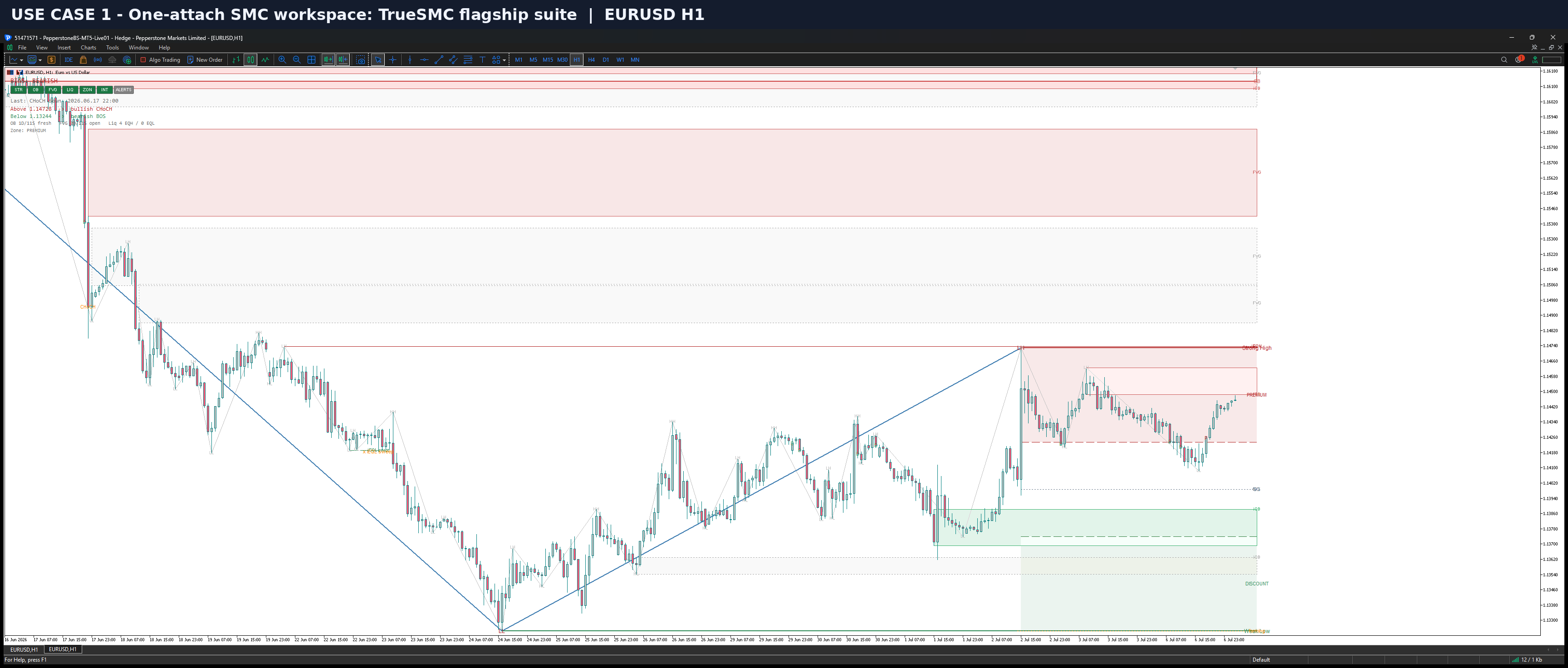
Five modules. One engine. One vocabulary.
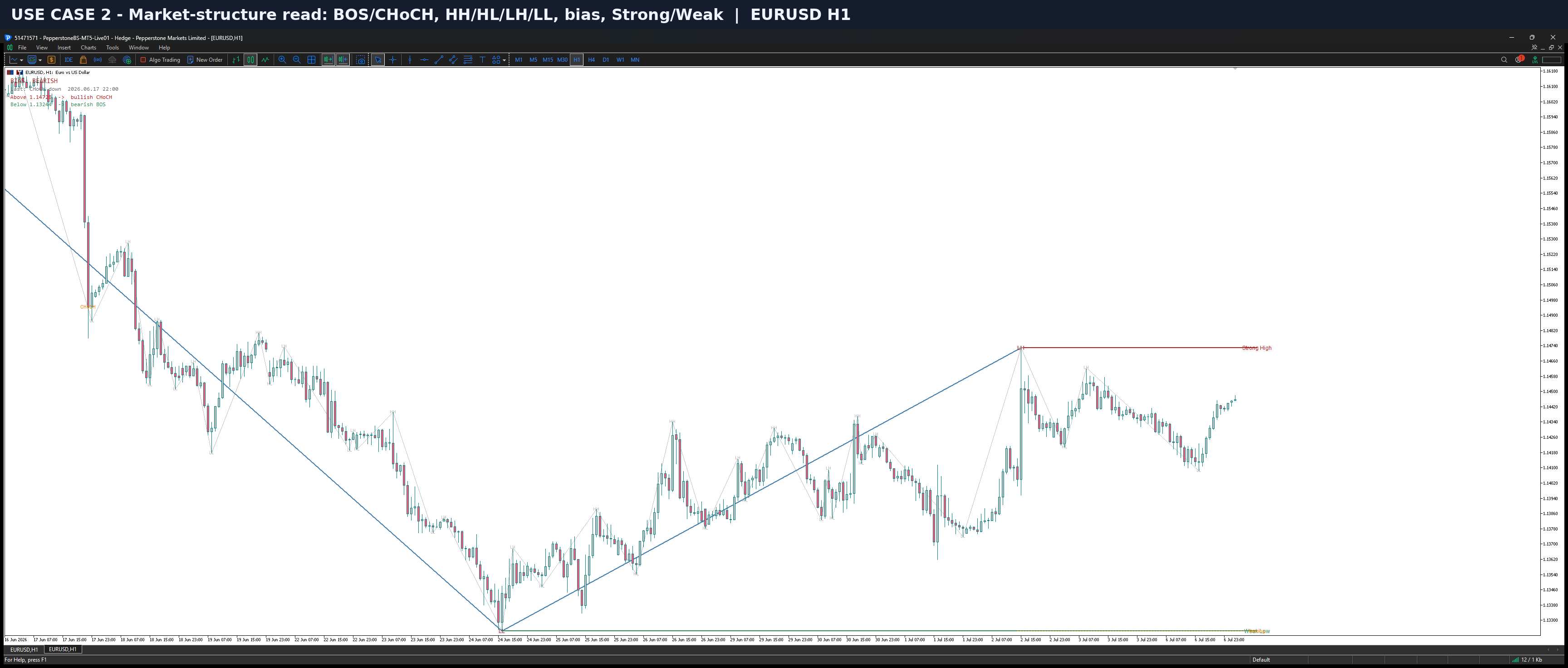
Market structure, at two resolutions.
The embedded engine tracks swings at two resolutions in parallel: Internal for near-term structure and Swing for the dominant trend that sets the bias. Every downstream module reads the same confirmed model — one vocabulary across the whole suite.
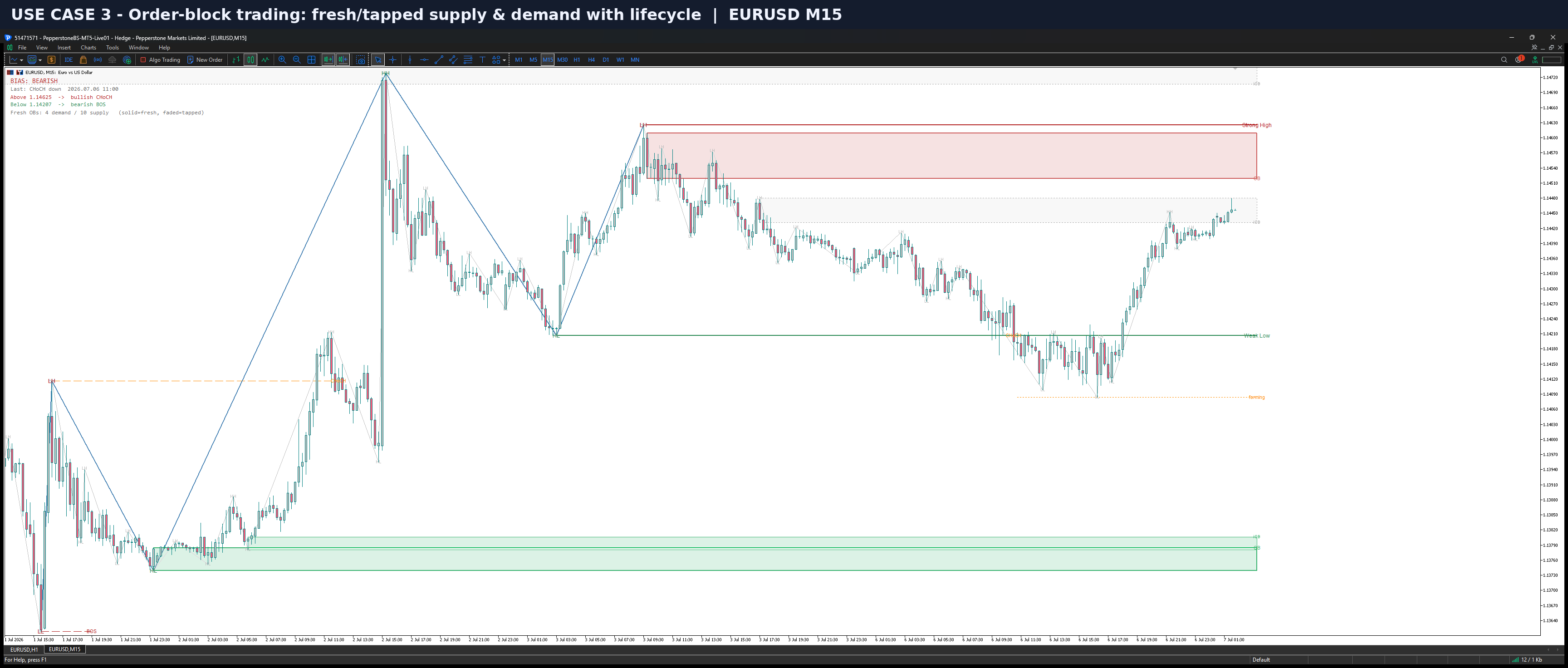
Blocks with a lifecycle, not just rectangles.
Each confirmed structure break creates one order block — the origin zone behind the move — drawn as a two-edged zone and filtered so a single outsized candle can't define a distorted block. From birth, every block is tracked: Fresh until first touched, Mitigated once tapped, Violated and removed when price closes through it.
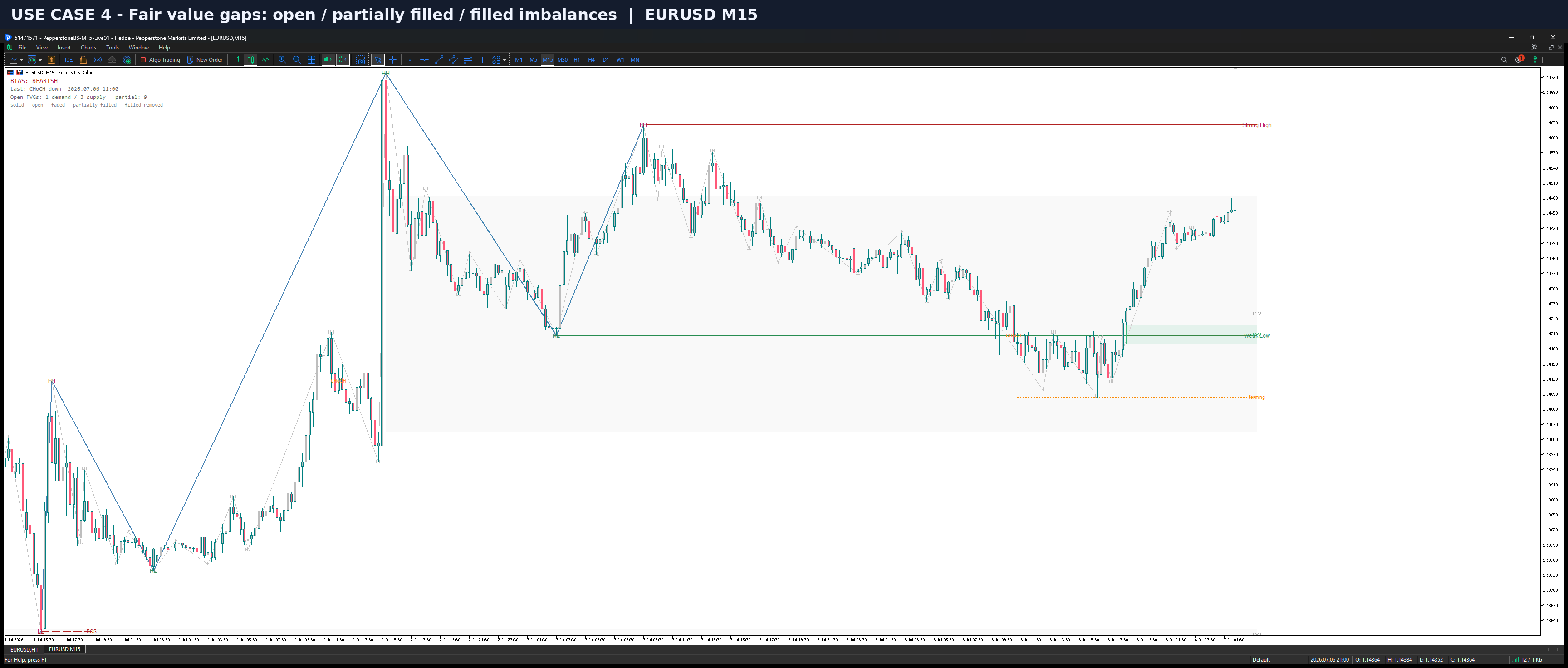
Imbalances that matter, tracked to the fill.
Fair value gaps are the imbalances a fast move leaves behind. TrueSMC filters them for significance against current volatility so micro-gaps don't wallpaper the chart, then tracks each one from Open through partial fill to fully Filled, when it is removed.
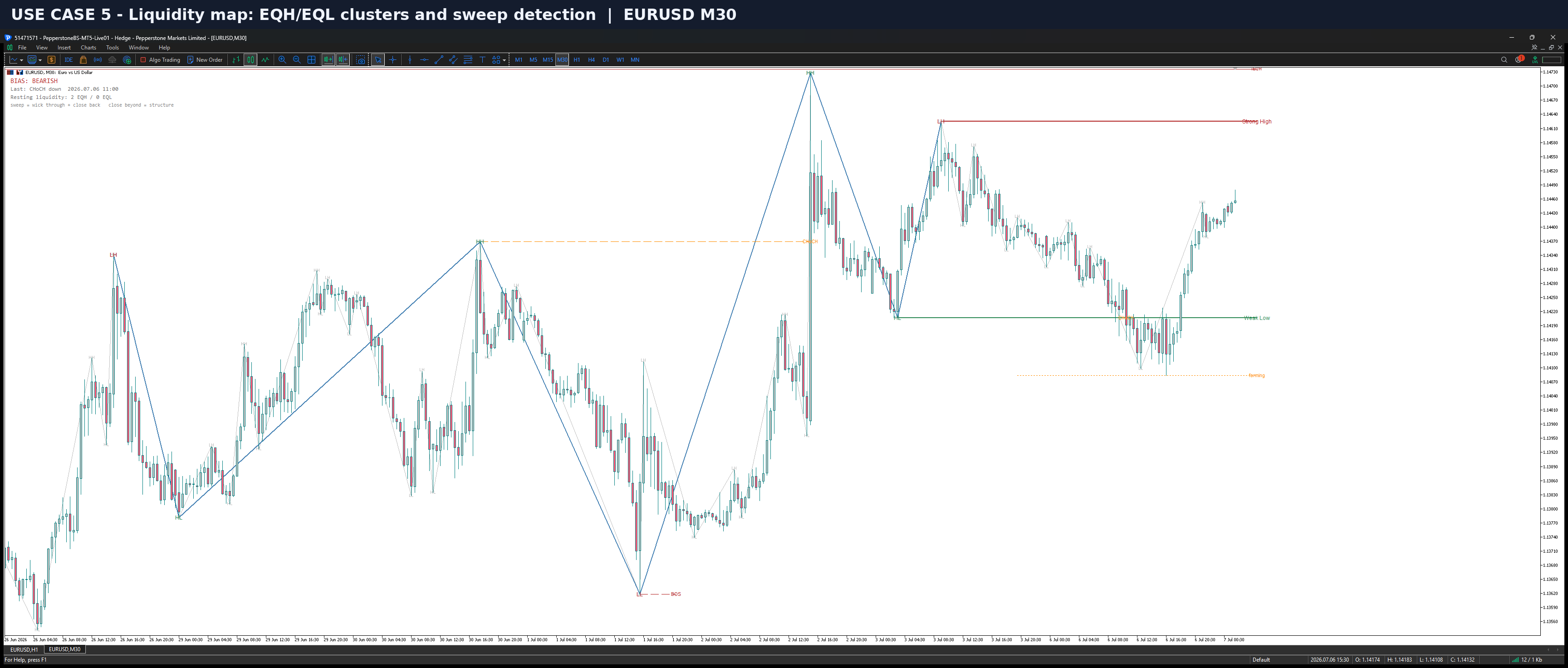
Equal highs, equal lows, and the sweep.
EQH/EQL clusters form where confirmed swings of the same type line up — resting liquidity, found without repainting because only confirmed swings qualify. A sweep is the classic trap: a wick through the cluster, a close back inside. Distinct from a break, which needs a close beyond.
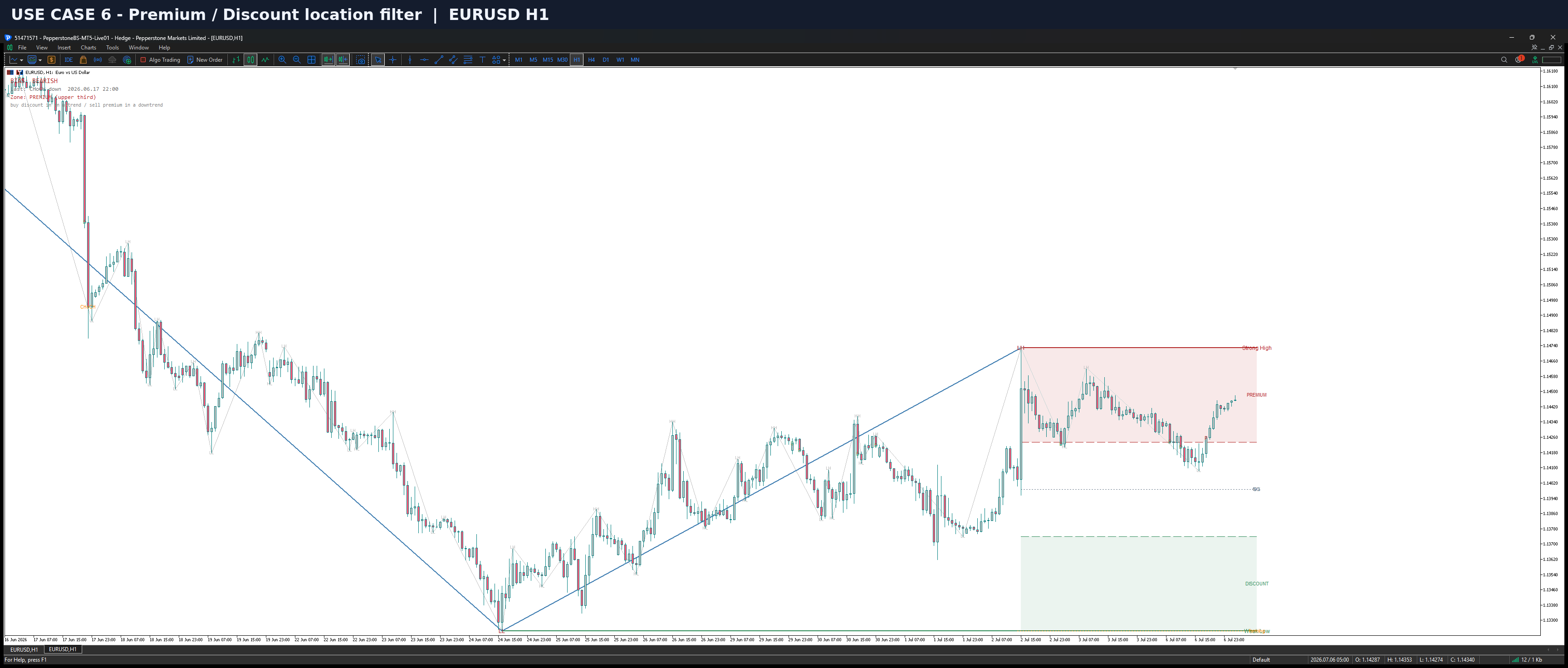
Where the setup sits in the range.
Between the current Strong and Weak levels, the range divides into thirds: Premium above, Discount below, Equilibrium around the middle. Bias-aware context — the same pullback reads differently at a Discount than at Premium — and it updates only when structure does.
Don't trust the claim. Run the test.
Most SMC tools look brilliant in history and hesitant at the right edge, because they quietly redraw the past. TrueSMC is built on four construction rules that make that impossible — and ships a five-minute test you can run in the Strategy Tester before you buy.
Closed bars only. Nothing is detected intrabar. A break of structure requires a bar close beyond the level — a wick through it publishes nothing.
Confirmed swings only. The engine builds structure exclusively from swings that can no longer move. The still-forming extreme lives in a separate, flagged provisional layer.
Written once. When an event is stamped — a break, a block, a gap, a sweep — it is final. State can advance, but history is never edited.
One language everywhere. The chart, the alerts and the EA Bridge speak the same model. What you see drawn is exactly what an EA reads — there is no separate display logic to fudge.
Your EA reads the same model you see.
TrueSMC publishes its whole model — structure state, block and gap lifecycles, liquidity events, zone context — through a documented, versioned signal contract your EA consumes with standard MQL5 calls. No chart-object scraping, no display logic to second-guess.
The full contract reference and a working sample EA ship with the product, so automation starts from a supported API instead of reverse-engineering pixels.
Seven events. Four channels. Your grid.
Every alert fires once, on a closed bar. Each event × channel cell is an independent toggle — push OB taps to your phone, keep BOS as a sound, silence the rest. Channels: popup, push, email, sound.
| Event | Meaning |
|---|---|
| BOS | Close beyond the last confirmed swing, with the bias — continuation |
| CHoCH | First close beyond the last confirmed swing against the bias — bias flips |
| OB tap | A fresh order block touched for the first time (mitigation) |
| OB violation | Price closes through an order block — the block is invalid |
| FVG fill | A fair value gap fully traded through and removed |
| Sweep | Wick through an EQH/EQL cluster, close back inside — liquidity taken |
| P/D entry | Close enters the Premium or Discount third of the current range |
One suite. Three ways in.
Purchase and activation happen on the MQL5 Market listing — MQL5 handles checkout, licensing and refund policy. Start free with Structure Lite, rent the full suite by the month, or buy once and keep every 1.x update.
The questions buyers actually ask.
Buy or rent?
Rent if you want a low-commitment month with the real product on live charts. Buy if you're staying: at $99 intro, three months of rent nearly covers the purchase, and every 1.x update lands free.
What are activations?
MQL5 licenses count installs per purchase. TrueSMC ships with 10 — enough for reinstalls, new machines, and a VPS without asking support for resets.
Is there a trial?
Two, honestly scoped: Structure Lite runs free on live charts (structure module only), and the Market's auto-generated demo runs the full suite in the Strategy Tester — where you can run the repaint test before paying.
Why is there confirmation lag?
A swing only becomes structure once it can no longer move. That delay is what makes the no-repaint guarantee possible — and it is printed on the label rather than hidden. The provisional layer shows you the still-forming edge, clearly flagged.
Can my EA read TrueSMC?
Yes. The suite publishes its model through the EA Bridge — a documented, versioned contract your EA reads with standard MQL5 calls. The full contract reference and a working sample EA ship with the product.
Put it on a chart. Watch it not move.
Run the repaint test in the Strategy Tester first — the demo is free and the test takes five minutes.